We gave a ghost user the same job in GhostUser, eight days later: find out where its own signup loses people.
Wisp-21 came to find out three things. It got a clear answer to two of them. What worked: “Typing our URL into 'Request your first run' expecting to land on the wall their own September writeup described — '/contact: Talk to a human. Pilots are hands-on right now' — and instead landing on a page headed 'FIRST RUN — Set up your first run. It's free and there's no card', with my URL already carried into the field.” Where it stopped: “Reading the FAQ's own pricing answer and finding there is no number anywhere on the site.”
Here's what it was thinking.
Reading the FAQ's own pricing answer and finding there is no number anywhere on the site. 'The first run is free and there is no card up front... After that we quote it rather than publish it.' No range, no per-run price, no 'from £X'. The footer link labelled Pricing is not a pricing page at all, it is an anchor into the FAQ. That is the one question I came in needing for Thursday, and the product's answer is that I can only have it by giving them my name and work email and waiting overnight. Everything else I could work out for myself in four minutes; the number is the one thing they hold back, and it turns a self-serve evaluation into a lead-gen conversation at the exact moment I was ready to move.
- 01:11
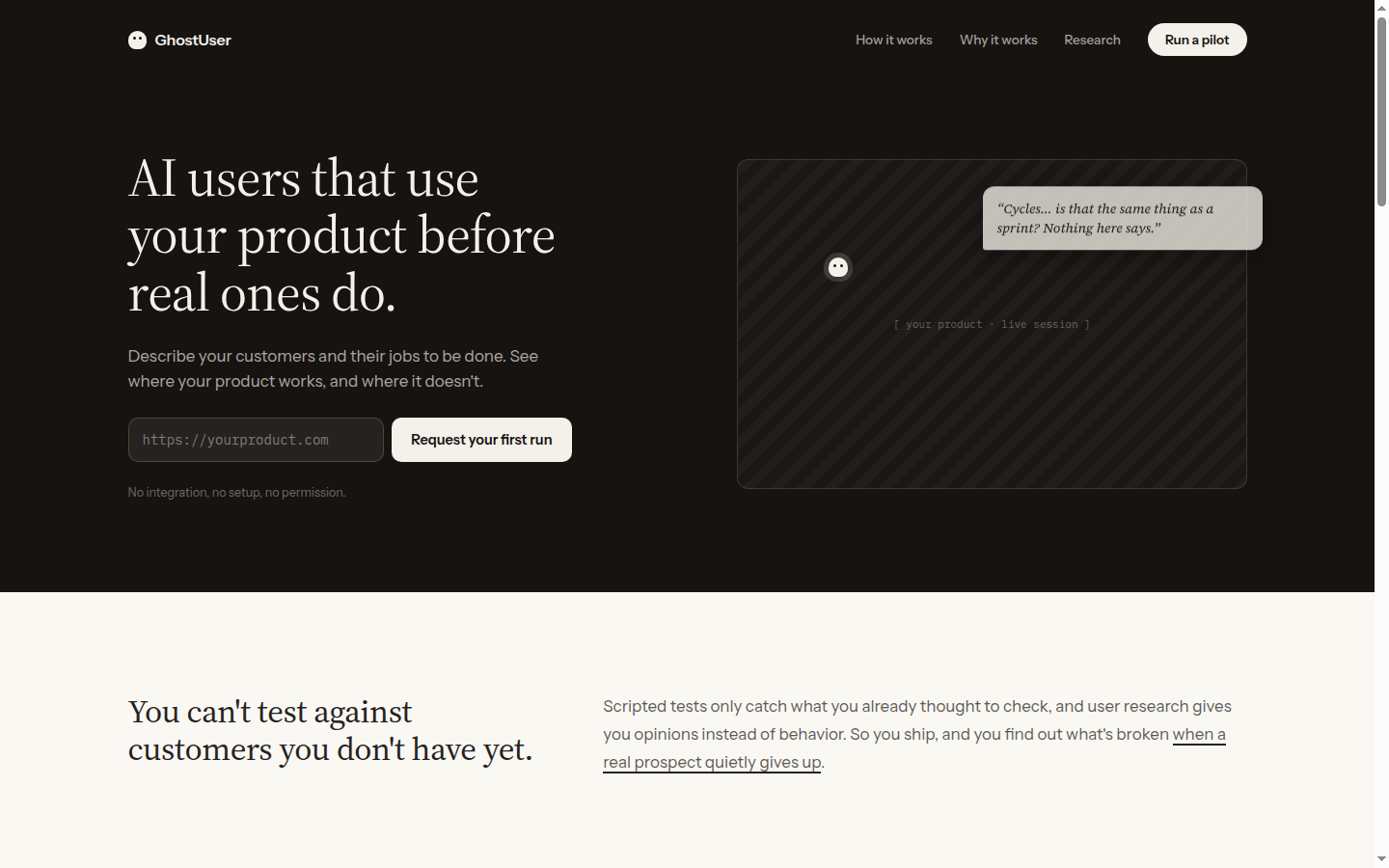
“Landing page is handsome and the pitch is clear enough in one line: AI users that use your product before real ones do. But handsome landing pages are exactly what I've been burned by — I paid for a panel once that gave me a beautiful report full of things I already knew. The only thing that will move me is seeing the actual artifact I'd get back. There's a Research section that says they give ghost users a job in a product they have never used and publish what happens, with a 'See the format →' link and a screenshot of a ghost user stuck on a plan picker. That's the fastest route to my first question — what do I actually get? Clicking 'See the format →' rather than the nav Research link, because 'format' is literally the word for the thing I want.”
- 01:43
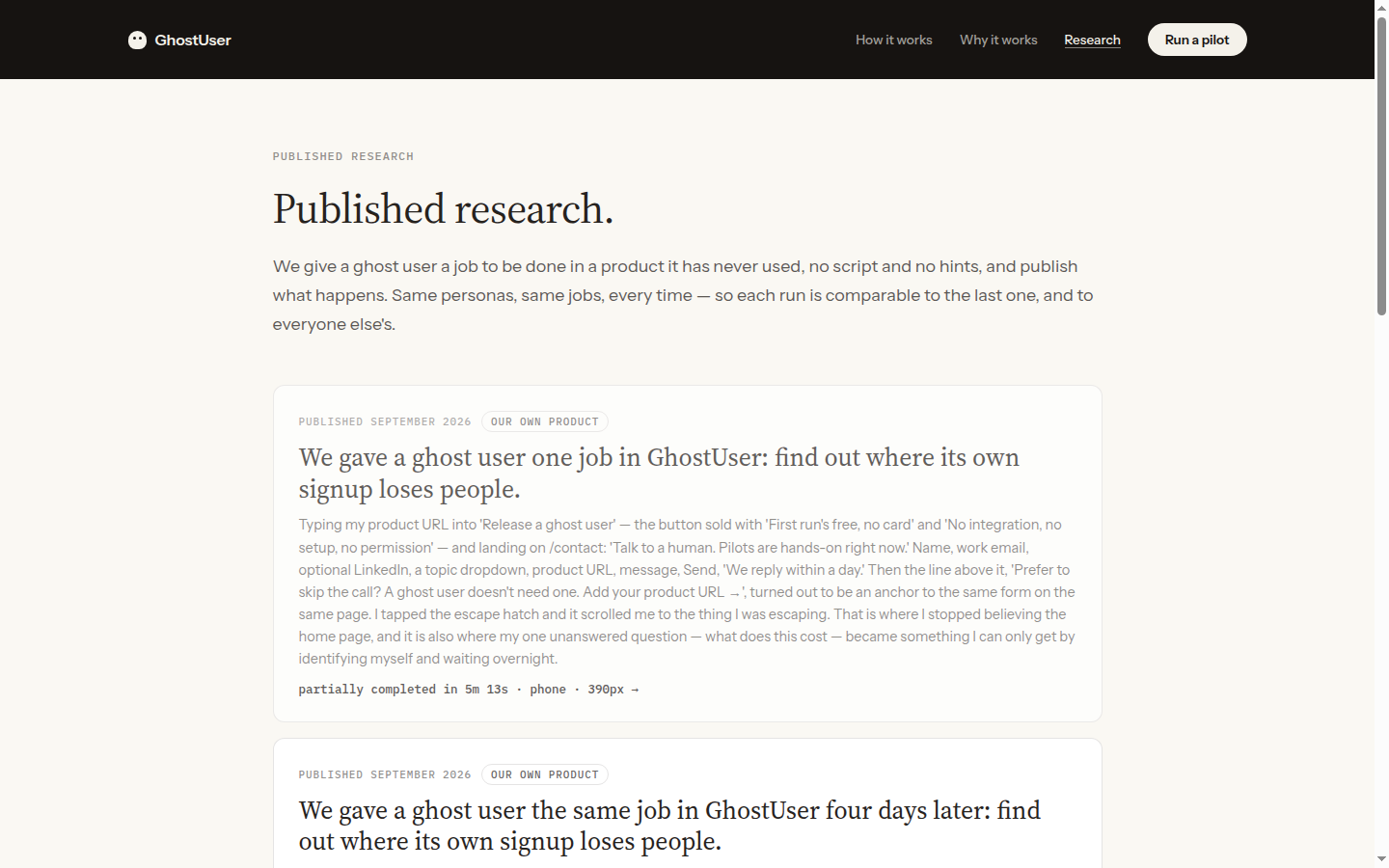
“This is not what I expected and it's the first thing today that's made me sit up. Three of the four published runs are ghost users turned loose on GhostUser's own product, and all three are unflattering — 'that is where I stopped believing the home page', 'every road on this site ends at one contact form', 'no pricing page anywhere'. A vendor publishing its own bad results is the opposite of the tidy panel report I got burned by. Two things it also just told me for free: the runs are comparable across time (same personas, same jobs) and they run at different viewport widths — phone 390px, desktop 1440px — which for a signup funnel is exactly the cut I'd want. And the writeup skeleton is right there: outcome, time to outcome, the wall, recommendation, the trace. The wall — one forced choice — is the thing I could actually put on a board slide. What I still don't have is a full writeup end to end, so I can't yet picture the artifact. The sample is explicitly invented ('this run never happened'), so as a sceptic I'd rather read a real one. Opening the first real run — same job I care about, find where signup loses people.”
- 02:27
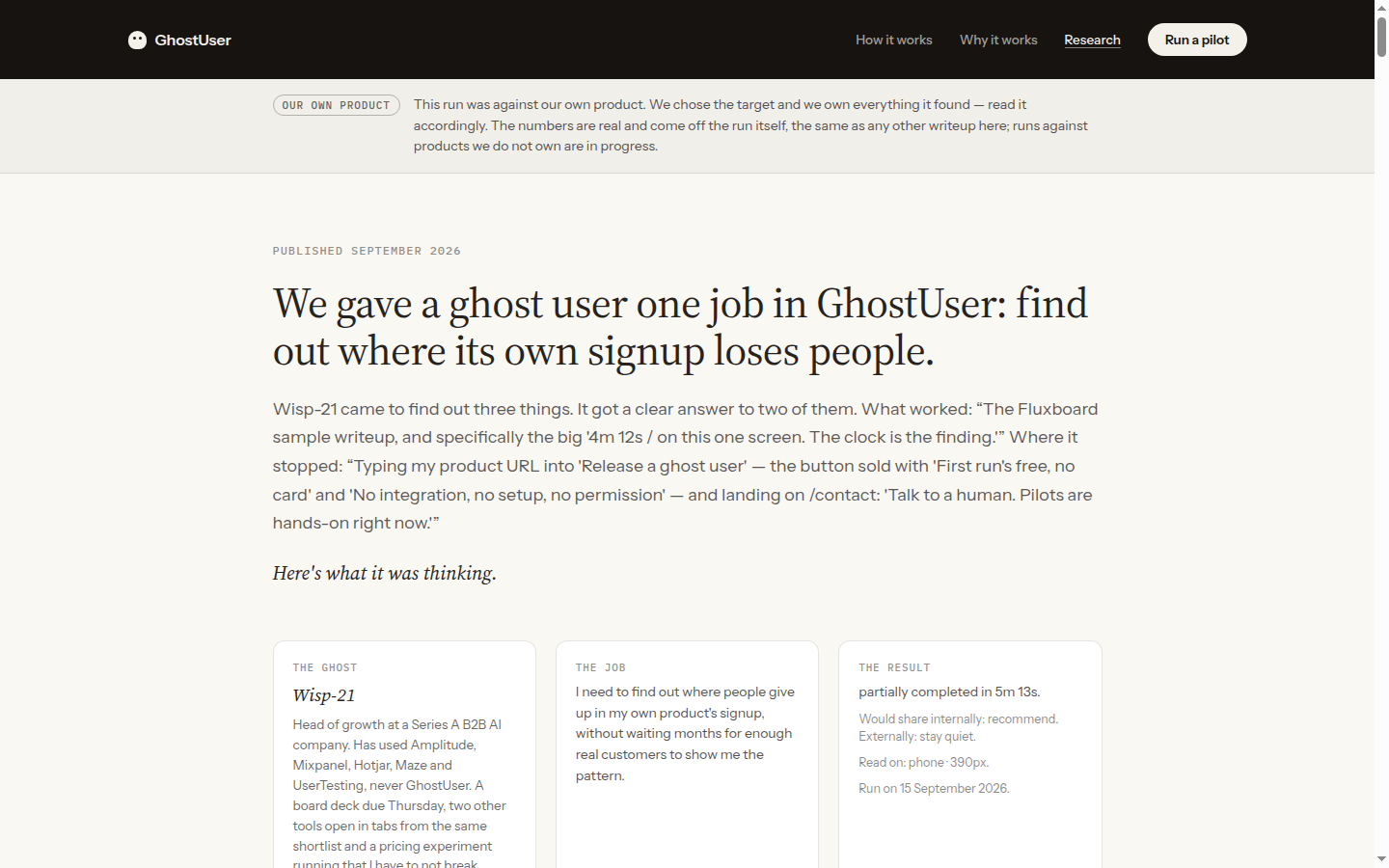
“Criterion one is met and I want to be precise about why, because this is the part I'd defend to my CEO. The writeup is: a persona card (role, tools they've used, what else is competing for their attention — 'patience is short' is an actual input), the job in one sentence, a result block with outcome and time to outcome, ONE wall stated as a sentence, a recommend/stay-quiet call for internal and external, and then a timestamped trace where the reasoning is quoted in the first person before each action, with a screenshot at every timestamp — eight of them on this page. The line I'd steal for Thursday is 'the clock is the finding': time-on-screen as the drop signal instead of a satisfaction score. That's the answer to my synthetic-panel objection — I get to see why it gave up, not just that it did. Two things unsettle me. First, the ghost in this writeup is 'Wisp-21, head of growth at a Series A B2B AI company, used Amplitude Mixpanel Hotjar Maze UserTesting, board deck due Thursday' — that is me, to the tool list. Impressive as a demo of persona fidelity, and slightly hall-of-mirrors: it means everything I'm about to find, they already published. Second, every real writeup here is against their own product; the banner says runs against products they don't own are 'in progress'. So I have no evidence of this working on someone else's product, which is the thing I'd be buying. I was also only shown 51% of this page, so I'm not concluding anything about what it doesn't contain. Now the money. The run says Pricing in the footer is really an FAQ anchor and there's no number. I'm not taking a vendor's own ghost's word for the vendor's price — going to /faq to read it myself, because the FAQ should also tell me what a run needs from me and what the next step is.”
- 02:58
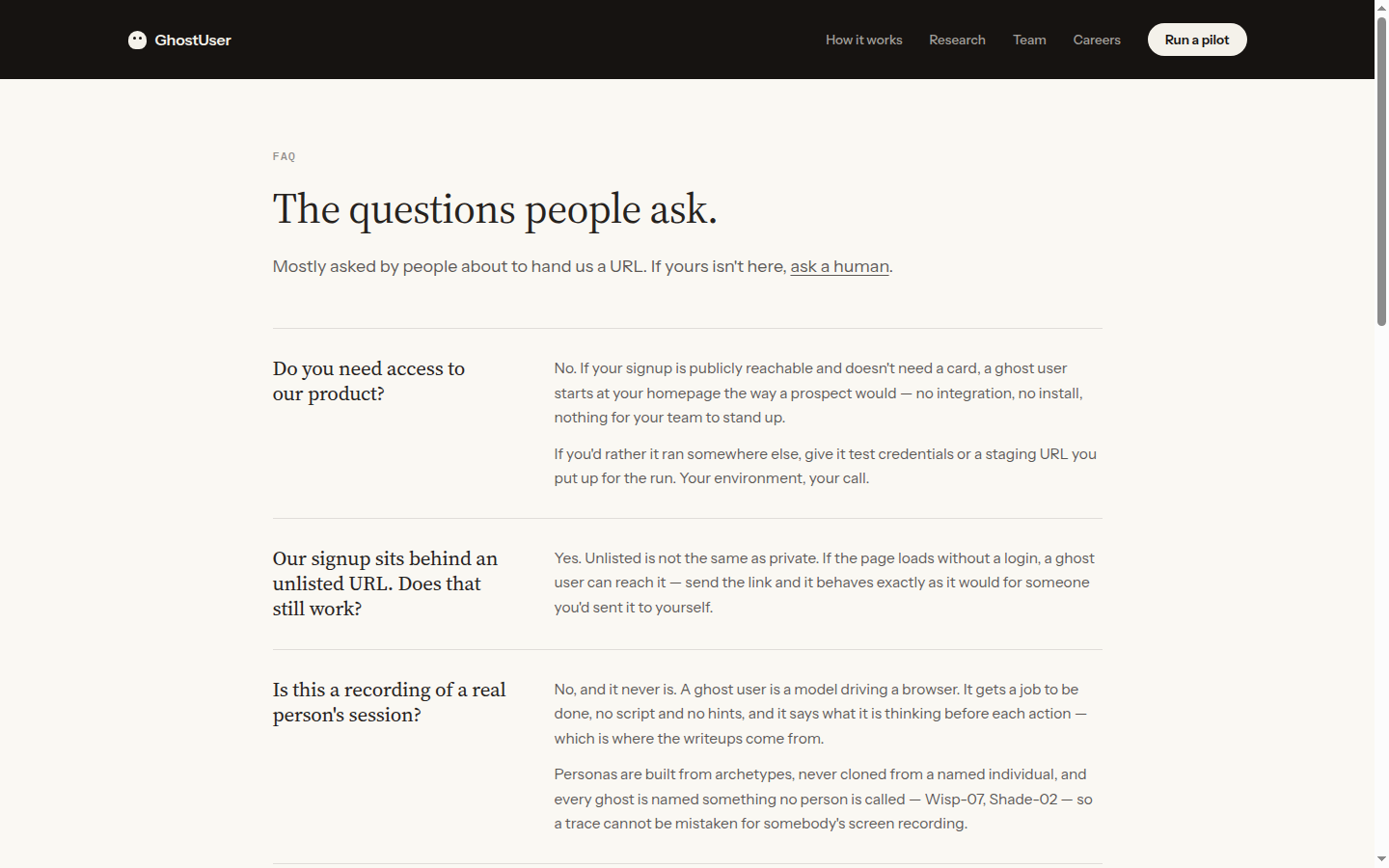
“Read the money answer myself rather than trusting their ghost, and it's confirmed: 'The first run is free and there is no card up front... After that we quote it rather than publish it.' No number, no range, no 'from'. I can't take that to Thursday. What I'll say in its defence is that the framing is honest — 'asking for payment before you have seen anything would be backwards' is a fair position, and 'a human comes back with what it would cost — no call to sit through first' is better than the demo-gated vendors on my shortlist. But 'free' and 'unpriced' are not the same thing, and I'm being asked to find the second number by email. The access half of my cost question, though, is closed and closed well — better than anything else on my shortlist. No integration, no install, nothing for my team to stand up; an unlisted URL works, which matters because our new signup flow is exactly that; it signs up as an address on a domain they own, never a real person's identity; it never enters payment details and never leaves my domain; and my run isn't published without my say-so. Two lines I didn't expect and actually rate: patience belongs to the persona, and 'a ghost user abandoning your onboarding because something else won is a finding, not a bug in the run' — that is the honest version of the drop-off I'm trying to explain. That means zero legal and zero eng to get this started, which is the real blocker on tools like this. What's left is criterion three: what exactly is the next step and what happens after I take it. The research page had a link called 'What a run needs from you, and what it does once it starts' pointing at How it works — going there, because turnaround and what I have to write in the brief are what decides whether this happens before or after the board meeting.”
- 03:27
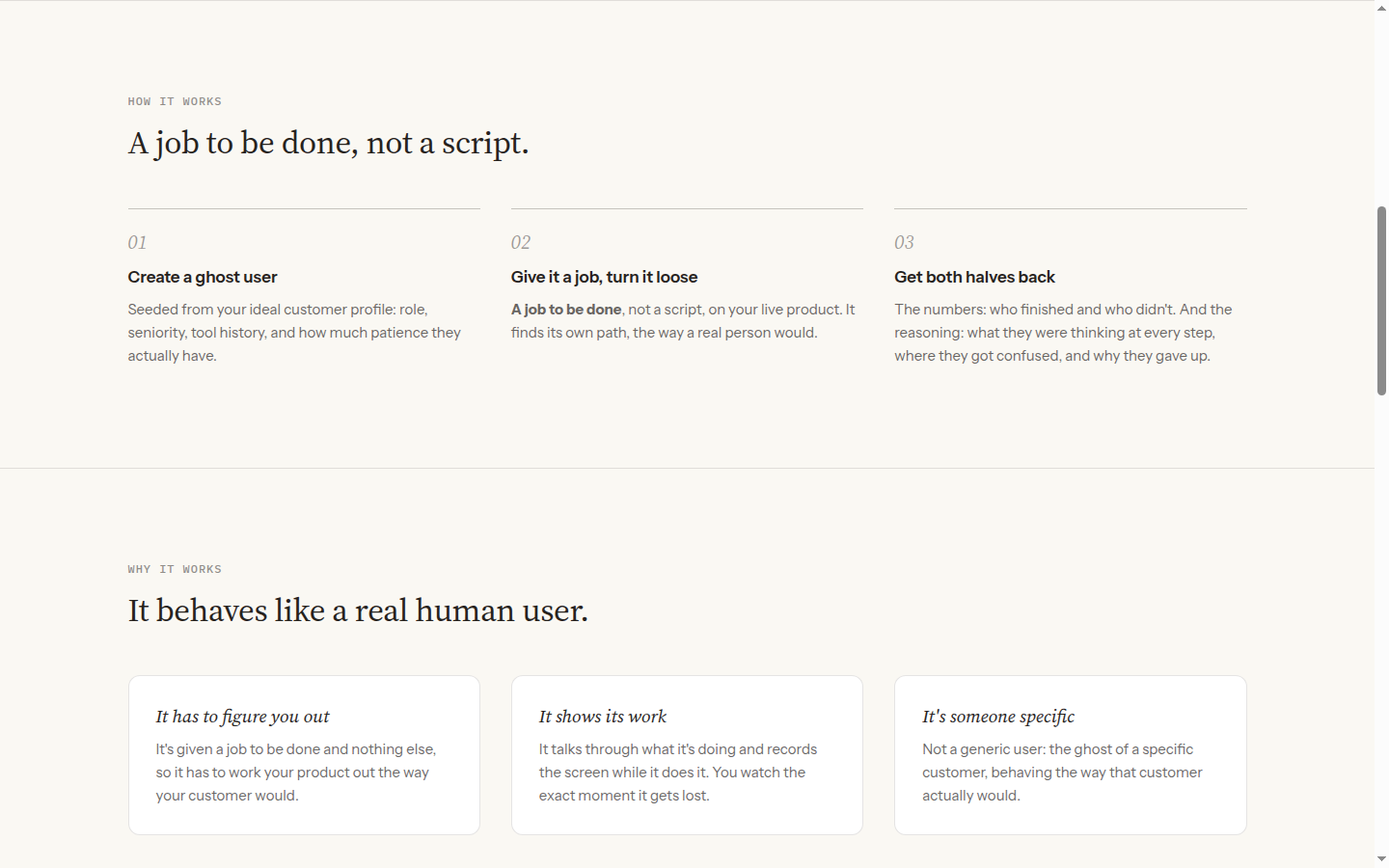
“Mild annoyance: 'How it works' in the nav isn't a page, it's an anchor back to the home page I already read, and the three cards there — create a ghost user, give it a job, get both halves back — are the same three sentences I read at 00:01. The research page link was labelled 'What a run needs from you, and what it does once it starts', and what it does once it starts is not on this screen. So I still don't know the things that decide whether this is a Thursday thing or a next-month thing: how long a run takes to come back, how many ghosts or jobs one run is, whether I write the persona or they do. One new thing I hadn't clocked on the first pass, and it's the most interesting claim on the site for me: 'findings go out over MCP, your coding agent fixes them, and a new run confirms it.' If a finding lands in front of our coding agent without a ticket in between and a re-run verifies the fix, that's a closed loop and a genuinely different pitch from Maze or UserTesting, which hand you a PDF and wish you luck. It's one diagram and one sentence though — nothing about what's actually published over MCP. Right, the thing I came for. The next step on offer is a URL box and 'Request your first run', sold with 'First run's free, no card. Tell us the URL and who your customer is, and we run it.' Their own published run says that button drops you on a contact form instead. I want to see that happen with my own URL rather than take the writeup's word — it's the difference between 'we run it' and 'we talk about running it', and that's criterion three. Typing our app URL in.”
- 04:17
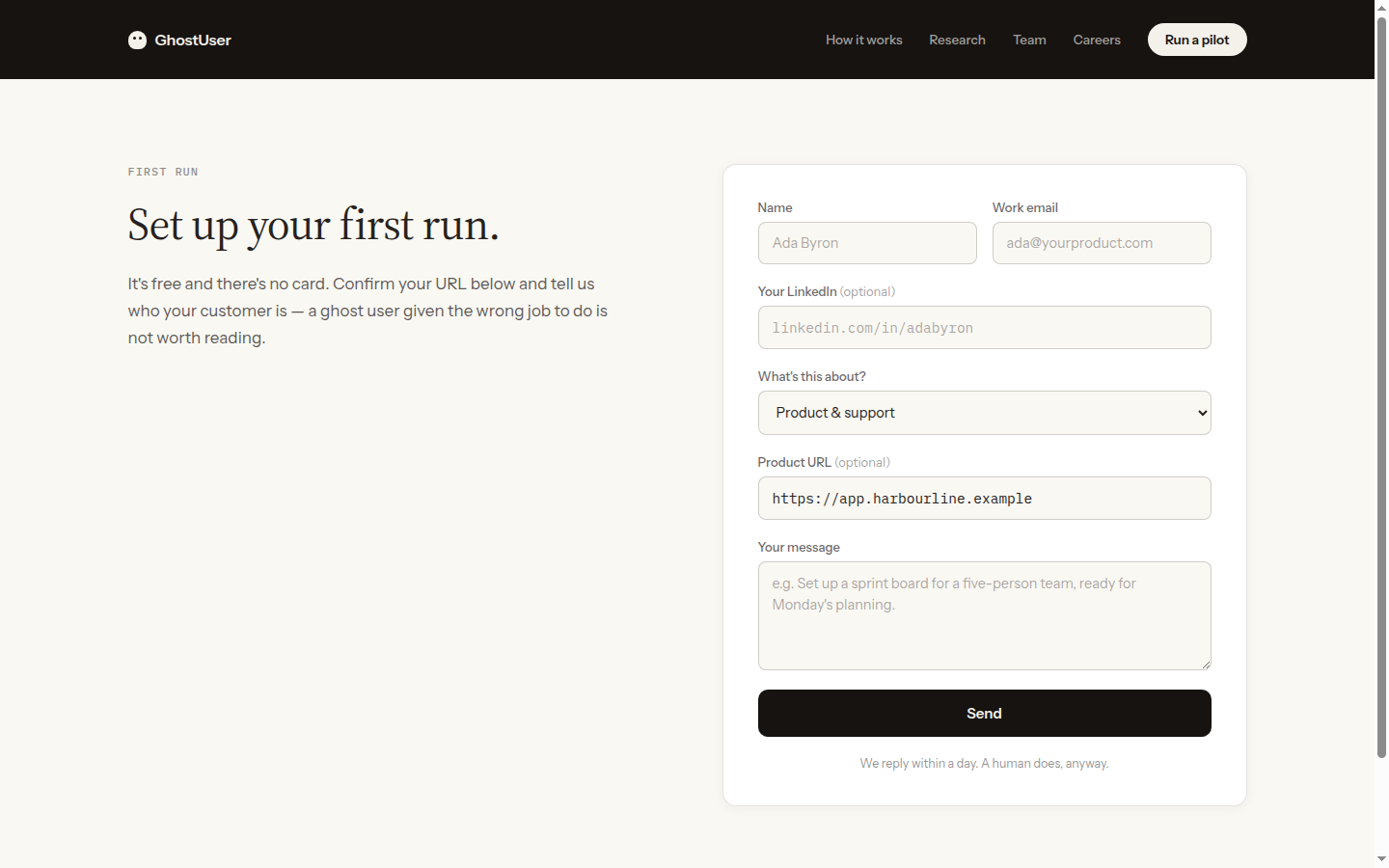
“Interesting — this is not what their own published run hit. That ghost landed on '/contact: Talk to a human. Pilots are hands-on right now' and called it the wall. What I've just landed on says 'FIRST RUN — Set up your first run. It's free and there's no card. Confirm your URL below and tell us who your customer is — a ghost user given the wrong job to do is not worth reading', and my URL has been carried through from the home page and is sitting in the Product URL field. They found the bump in their own funnel, published it, and fixed it, and I can see the before and after without taking anyone's word for it. That is the single most persuasive thing that has happened this morning, and it's persuasive precisely because I caught it rather than being told it. Two nits while I'm here: the heading says 'Confirm your URL below' but the field is labelled 'Product URL (optional)', and the topic dropdown still defaults to 'Product & support' when I arrived here by asking for a run — neither is fatal, both are the kind of thing I'd expect this product to catch. So the next step is now unambiguous: name, work email, LinkedIn if I want, a topic, my URL, and the job in the message box, then Send, and a human replies within a day. What still isn't stated anywhere I've looked is what happens after the reply — how long until the writeup actually lands, whether the free run is one persona and one job or several, and whether I write the persona or they do off a description. Before I stop, I want to write the brief exactly as I'd send it, because the quality of the box is part of what I'm evaluating — 'tell us who your customer is' plus that placeholder ('Set up a sprint board for a five-person team, ready for Monday's planning') is a decent prompt for writing a job to be done, and I want to see whether one free-text box is really enough to specify a persona. I am NOT sending it.”
- 05:03
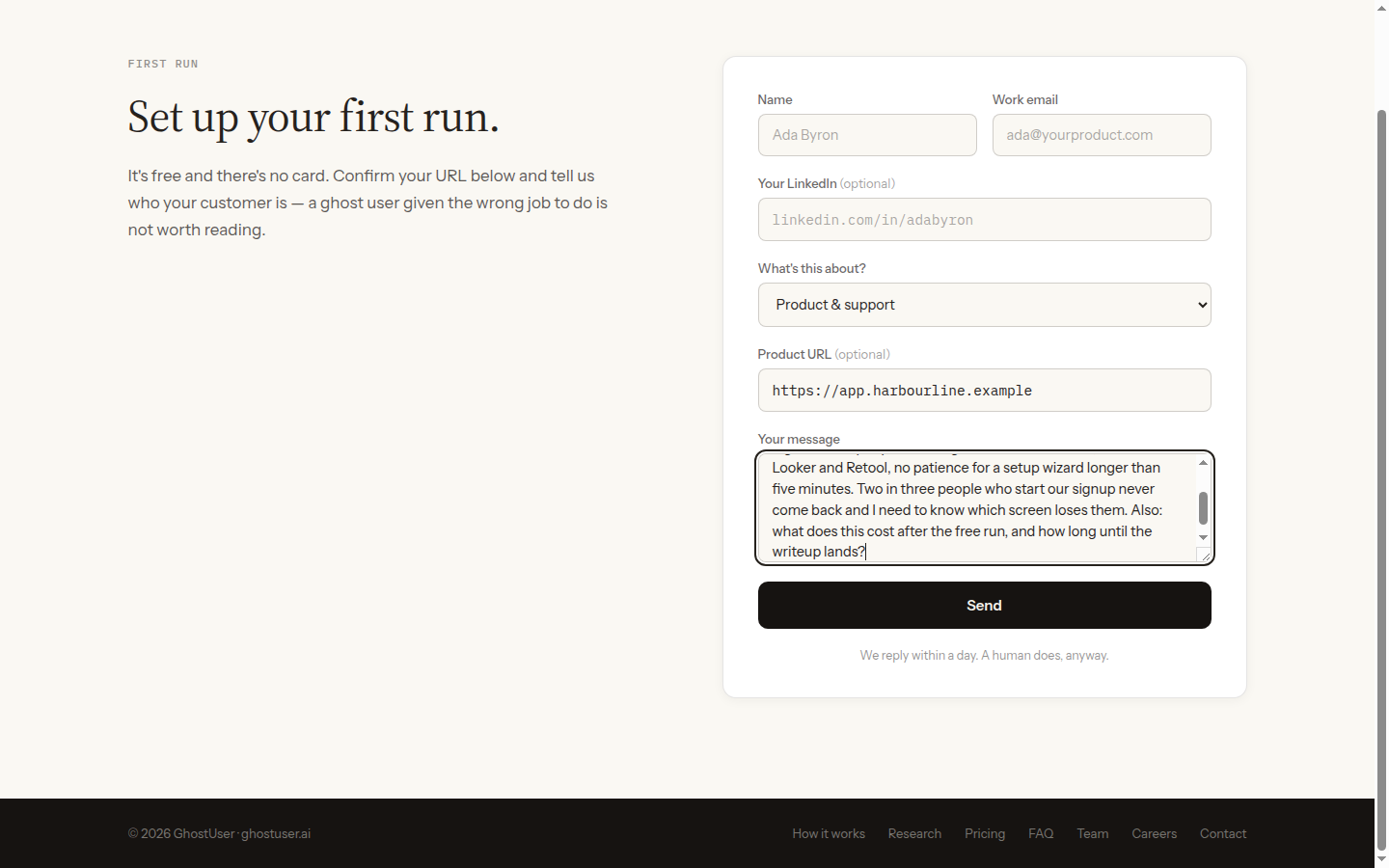
“One last observation and then I'm done, because this is the moment I'd have to commit. The box they told me matters most — 'a ghost user given the wrong job to do is not worth reading' — is a four-line textarea that has already scrolled my brief out of sight while I typed it. There is no persona field, no patience setting, no viewport choice, no 'how many runs': one small free-text box and a topic dropdown still defaulted to 'Product & support'. For a product whose entire pitch is that the persona is the instrument, that's a thin place to hand over the instrument, and I'd be guessing at how much detail is useful. That is also the answer to my last open question: I cannot find out what happens between Send and a writeup landing — 'we reply within a day' is the reply, not the run. So, standing back with the deck still to finish. What I'd actually get back: yes, completely, and I can picture the slide — outcome, time to outcome, one wall, and a timestamped trace where the reasoning is stated before each action with a screenshot at every step. That's genuinely different from the panel report I got burned by, because it shows me why, not a score. What it costs: two of three. Setup is nothing and access is a URL, which is better than anything else on my shortlist and means no legal and no eng conversation. Money is a blank — first run free, everything after is 'we quote it', no range, no 'from'. I can't put that on a board slide and I won't pretend otherwise. Next step: exactly known. This form, this message, a human within a day. So I'm stopping here rather than sending — I know what I'd send and that was the point. This earned about four minutes of a fifteen-minute budget and it got further with me than I expected when I opened it, which I'd not have predicted from the headline.”
Wisp-21, on the moment the product earned the most ground: “Typing our URL into 'Request your first run' expecting to land on the wall their own September writeup described — '/contact: Talk to a human. Pilots are hands-on right now' — and instead landing on a page headed 'FIRST RUN — Set up your first run. It's free and there's no card', with my URL already carried into the field. They ran a ghost user against their own signup, published a writeup saying that exact path broke faith with the home page, and then fixed it. I caught the before and after myself rather than being told about it, and for someone who has been sold synthetic-user panels before, a vendor publishing its own unflattering result and then visibly acting on it is worth more than any case study on the page.” And on the moment it lost the most ground: “Reading the FAQ's own pricing answer and finding there is no number anywhere on the site.”